
by Annalise DeVito
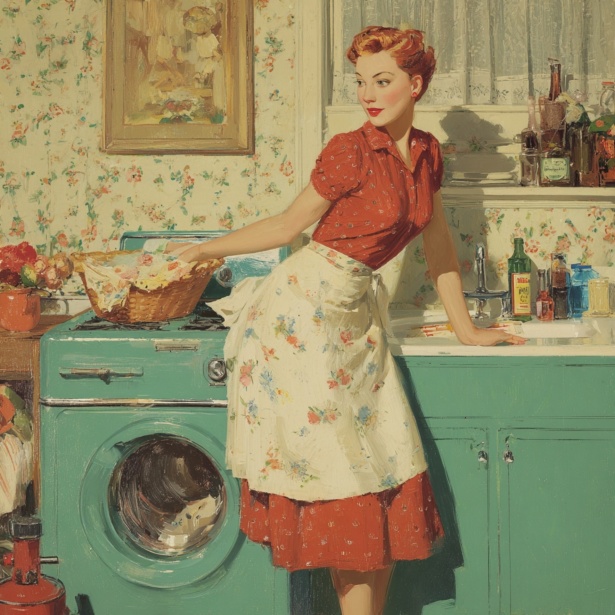
Post World War II marked significant changes in the United States. The war was over, and people started to return to life as they knew it. During the war, many women had entered the workforce, taking on the roles men had left behind. However, once the war ended, women found themselves back in the home. From greater independence back to domestic responsibility, the 1950s United States culture created the image of a perfect family and a perfect housewife.
Additionally, advertisements reinforced this ideal, promoting good and new technologies that made housework easier for women, prompting them to stay at home. They portrayed domestic life as modern, fulfilling, and desirable. The 1950s were a period of conformity, of having a perfect family and living the American dream. In her text, The Feminine Mystique (1963), Betty Friedan argues that many women were encouraged to find fulfillment through marriage, motherhood, and domestic responsibilities rather than through careers or personal ambitions. She says that while this was presented as a path to happiness, it often limited women’s opportunities in life. She writes that many women were unhappy despite having what society deemed fulfilling. She called this dissatisfaction “the problem that had no name.”[i] Women were encouraged to give up personal ambitions, while the media and advertisements glorified domestic life. While women were able to attend college, these institutions often steered them towards marriage rather than careers. And the women who wanted careers were told that wanting more than a home and marriage was selfish or told that they did not want this life. It is important to note that Friedan is not arguing that motherhood and marriage are bad; rather, she argues that women should have the freedom to choose their own path, including a family life if they choose (Friedan, 1963).
Amid these circumstances the film Mona Lisa Smile (2003), directed by Mike Newell, takes place. Set in 1953 at the prestigious women’s college of Wellesley, the film follows the arrival of an art history professor, Katherine Watson, who begins to challenge the ideals to which society has grown accustomed. The expectations presented in the film primarily reflect the experiences of white, upper-class women who had access to elite educational institutions such as Wellesley College. The women of Wellesley were often considered among the most educated in the country, a status shaped by their race and class. Here, the smartest women in the country were expected to channel their intelligence into preparing to be perfect wives for their ambitious husbands. While this ideal did not represent all women in the 1950s, it reflects one influential model of womanhood that shaped cultural expectations during the period. Throughout the film, Katherine Watson comes up against the school’s expectations for her teaching, as well as those of one of her traditionalist students, Betty Warren, who strongly represents the dominant values of the time. Watson also has an impact on one of her students, Joan Brandwyn, who struggles with choosing a career or becoming a mother. While the film explores themes of feminism, education, and resistance, its main message revolves around the power of choice. Rather than arguing that one path is better than the other, the film shows that women should have the freedom to decide their own future. As bell hooks argues in Feminist Theory: From Margin to Center, feminism seeks to challenge systems that limit women’s choices and autonomy (hooks, 1984). This idea is reflected throughout the film as the characters navigate the tension between societal expectations and personal choice. Through the journey of Katherine Watson, Betty Warren, and Joan Brandwyn, Mona Lisa Smile shows the struggle to choose between societal expectations of marriage and their own dreams, demonstrating the challenge to traditional gender roles, the defense of those expectations, and the difficult decisions women must make about their dreams. In 1950, society dictated that women should be calm, agreeable, and supportive of their husbands. Their worth was often perceived through the eyes of men. The term “Mrs. Degree” was often used to define the purpose and degree path for well-bred (read: White and wealthy) women, as education was believed to greatly improve one’s chances of finding a successful husband. Nancy, a teacher and a Wellesley graduate, teaches speech, elocution, and poise. In one scene, Nancy outlines a hypothetical scenario. “Your husband is at a crossroads in his career. He’s competing for a promotion against two rivals, Smith and Joan. To get the edge, you have wisely decided to invite the boss and his wife to a 7:00 dinner” (Newell, 2003). Nancy emphasizes that women’s behavior and domestic skills could directly influence their husbands’ professional success. She informs the girls that the boss is testing you as much as your husband. This line reinforces the idea that a wife’s actions are viewed as an extension of their husband’s career and reputation. Then, at the end of the lesson, Nancy tells the girls, “In a few years, your sole responsibility will be taking care of your husband and children. You may all be here for an easy A, but the grade that matters the most is the one he gives you, not me” (Newell, 2003). The message is clear in this moment: your achievement is measured by your husband’s advancement, and women have a clear, set-in-stone role.
When the film begins, we see that Katherine Watson does not conform to these standards. Unlike her colleagues, Nancy challenges her students to “look beyond the image” (Newell, 2003) and constantly questions societal expectations. After her students memorized the entire syllabus and textbook and could identify every artwork she had prepared, she decided to take a new approach to teaching. She immediately disrupts the norm by introducing modern art into her classroom. “There’s no textbook to tell you what to think” (Newell, 2003). This sentence carries symbolic meaning: it applies not only to art but also to societal standards, emphasizing independence over expectations. Katherine encourages critical thinking and independent interpretation. It soon becomes clear that Betty Warren, one of Watson’s students and a traditionalist, writes an article in the school paper stating that Katherine Watson has challenged the roles they were born to fill. In response, Katherine develops the film’s most powerful messages. The classroom is tense as she puts up the first slide. A woman holding up a can of Dutch Cleaner, with the words “Could you get a job as a housewife? Use Old Dutch Cleaner!” Watson goes through ad after ad, her anger rising. A guide on “How to measure your wife for an ironing table” shows a man measuring a woman’s skirt length. “A girdle to set you free” (Newell, 2003). Freedom through restriction. These advertisements expose how the media reinforces narrow ideas of what women should aspire to be, despite contradictory messages. The advertisements tell them that happiness can only be achieved through embracing domestic roles. As Jean Kilbourne argues in Killing Us Softly (2010), advertisements do more than reflect cultural values; they also create and reinforce them. The images presented to the women shape expectations about what they should desire and ultimately become, making domesticity appear to be the natural path to fulfillment. Even in the ads shown in the movie, the women are treated as objects rather than human beings, focusing on their body parts instead of the whole person, or portrayed as pretty decorations. While the ads seem small individually, the constant repetition gives them power, pushing expectations about gender and body image and telling women what they should want: finding a husband, looking beautiful, raising a family, and maintaining a home (Kilbourne, 2010).
When the film first starts, Betty Warren is a strong anti-feminist. She is the defender of tradition and society’s expectations of her. She has grown up with these beliefs and views them not as limitations but the natural order of a woman’s life. Her views are not far from her mother’s, who is very controlling and dictates what she should do and think. When Betty is getting married, her mother wants Betty’s husband, Spencer, to read a special poem for their wedding. Betty then informs her mother that Spencer does not want to do the poem. She then quickly takes Betty to a separate space and pushes her against the wall, saying, “A good wife always lets her husband think everything is his idea. Even if it’s not” (Newell, 2003). Then, after taking a breath and straightening her daughter’s jacket, she says, “Why don’t you see if you can’t nudge the idea into his head, hm?” (Newell, 2003). In the end, Betty follows her mother’s advice and gets Spencer to recite the poem. This moment shows how women were taught to manipulate situations. Their ideas could never be accepted, but if they came from their husbands, then that was okay. As the film progresses, the viewer witness Betty’s marriage to Spencer is very forced and shows cracks. Everything she does surrounds her husband. However, it is soon revealed that Spencer cheats on her, and when she finds out about this, she is told to stay silent. When Betty seeks refuge at her home, she is rejected. Her mother commands, “Now you are going to fix your face and wait for Spencer. Spencer’s house is your house” (Newell, 2003). From this sentence, you can see that women were supposed to ignore their husbands’ wrongdoings. To fix themselves back up and wait for them to come back home. Here, Betty’s pain and betrayal are dismissed to keep up a good appearance in the name of her family and husband. This expectation reflects Freidan’s critique of the postwar ideal of womanhood, in which women were encouraged to prioritize their roles as wives above their own needs and identities (Friedan, 1963). Betty’s mother values the appearance of a successful marriage more than her daughter’s happiness. It is in this moment that Watson’s influence starts to take shape; it is subtle but significant. Though Betty initially resented Watson for challenging the ideal and undermining tradition, Spencer’s indiscretions and Watson’s teachings began to change Betty’s thinking. In the end, Betty chooses to divorce Spencer. Her mother encourages her to remain silent, saying, “You don’t wash your dirty laundry in public,” and calls the betrayal merely “a period of adjustment” (Newell, 2003). By societal standards, Betty is supposed to keep her problems to herself. Women, especially, were supposed to act as if everything was alright and that there were no problems in their marriages or households. She asks her mother as she is looking at a photo of the Mona Lisa, “She’s smiling. Is she happy? She looks happy, so what does it matter?” (Newell, 2003). Women were taught to smile through the pain. They look happy, so what does it matter what they are going through? By rejecting both her husband and her mother, Betty gains autonomy in her choices.
Joan Brandwyn presents a different side of choice. Joan is a smart and ambitious pre-law student, yet in a conversation with Watson, she says that after she graduates, she plans to become a mother. This surprises Watson because Joan clearly has the intelligence and ability to pursue a professional career. No one pressures Joan; she genuinely wants to get married and have kids. However, her dream is to become a lawyer at Harvard Law School, and with Katherine Watson’s help, she is accepted. But with this, Joan is at a crossroads. In the 1950’s, women did not work and were mothers. It was one or the other. Tommy, Joan’s fiancé, is a good man; yet he still embodies the dominant expression and practices of masculinity in the 1950s. Even though he cares about Joan, he still believes that her future will be supporting him and their family. In a scene with Katherine, he thanks Watson for helping Joan get into Harvard Law School, saying, “She will always have that” (Newell, 2003). This suggests that Joan’s acceptance is an accomplishment that she can keep even if she does not attend. And when Watson is confused by his statement, he replies, “Well, that’s an awfully long commute to get dinner on the table by 6:00” (Newell, 2003), revealing his assumption that her primary responsibility will still be in the home. Even later in the movie, Betty criticizes Joan for considering law school, saying, “You don’t want to be a lawyer” (Newell, 2003), as if this is something she does not want. She thinks Joan should get married and have kids as they planned. She states, “You are this close to everything you wanted, and this close to losing it” (Newell, 2003). These moments show the pressure Joan faces from those she cares about to choose marriage and family over her job. Eventually, Joan chooses to marry Tommy, giving up her dream of becoming a lawyer. The confrontation between Joan and Watson is another powerful moment. Watson tells Joan she doesn’t have to choose, but Joan retorts, “No, I have to, I want a home. I want a family. That’s not something I’ll sacrifice” (Newell, 2003). Joan’s response shows that personal choice is complicated, and that it can be difficult to disentangle social expectations, viable options, and choice from one another. Watson tells her that “no one is asking her to sacrifice anything,” expressing her belief that there is room for multiplicity in the femininity of the future (Newell, 2003). When Watson expresses fear that she will regret her decision, Joan replies, “Not as much as I’d regret not having a family. You stand in class and tell us to look beyond the image, but you don’t. To you, a housewife is someone who sold her soul for a center hall colonial. She has no depth, no intellect, no interest” (Newell, 2003). In this moment, Joan challenges Katherine’s assumptions that a wife can still be independent and smart. This is a pointed moment in the film and shows that choice is not always so simple. Watson must confront her own understandings of marriage. Joan forces her to recognize that feminism is not just prescribed to a single path. This moment reflects hooks’ argument that feminism should expand women’s choices rather than dictate a single correct way to live (hooks, 1984). In this moment, Joan demonstrates that empowerment does not come from choosing a career over a family but having viable options between which to choose.
Mona Lisa Smile does an excellent job of showing how these characters struggle with the choice of choosing in a society where there is none. Katherine Watson disrupts the norm by challenging Wellesley College’s conformity. Through her teaching and influence, she encourages her students to question the expectations that society has placed on them. She makes a change in her students, and most of all, in Betty. Betty starts the film by conforming to the norm, but by the end, she realizes she can think for herself. Mona Lisa Smile shows us how the 1950s were a time of domestic ideals and lack of choice. Women were told who to be, how to act, and what to desire. Society created a narrow image of success for women, centered around family and marriage. Their dreams were not to be followed. Through the three characters, we can see that empowerment does not come from following a single path but from having the freedom to decide one’s own future.
Bibliography
Friedan, Betty. The Feminine Mystique. W.W. Norton & Company, 1963.
hooks, bell. Feminist Theory: From Margin to Center. South End Press, 1984.
Kilbourne, Jean. Killing Us Softly 4: Advertising’s Image of Women. Cambridge Documentary Films, 2010
Newell, Mike. Mona Lisa Smile. Columbia Pictures, 2003.
[i] Friedan, Betty. The Feminine Mystique. W.W. Norton & Company, 1963, p. 15.
Annalise DeVito is an undergraduate student at West Chester University of Pennsylvania, majoring in Secondary English Education. She enjoys reading, studying history, analyzing films, and exploring how costume design shapes characters. Outside of academics, she enjoys musicals and singing in the choir. She will complete her student teaching placement this fall. This is her first publication.